Remember to remember. This is God’s instruction to His people. Whether Yom Kippur or Rosh Hashanah or even Hanukkah, each of these holidays reminds the people what He has done. While those holidays may be familiar to you, let’s take a look at a holiday that is not quite as familiar: Purim or the Feast of Lots. In 2026, this feast begins at sundown on March 2.
In order to understand Purim, we first have to remember the story of the unlikely Jewish queen of Persia, Esther. In short, after Queen Vashti refuses a very public drunken order from her husband, the Persian king Ahasuerus finds himself in need of a new queen. When a kingdom-search is undertaken, Esther, a young Jewish orphan is taken into the palace and ascends to become Ahasuerus’s new queen without the revelation of her ethnicity.
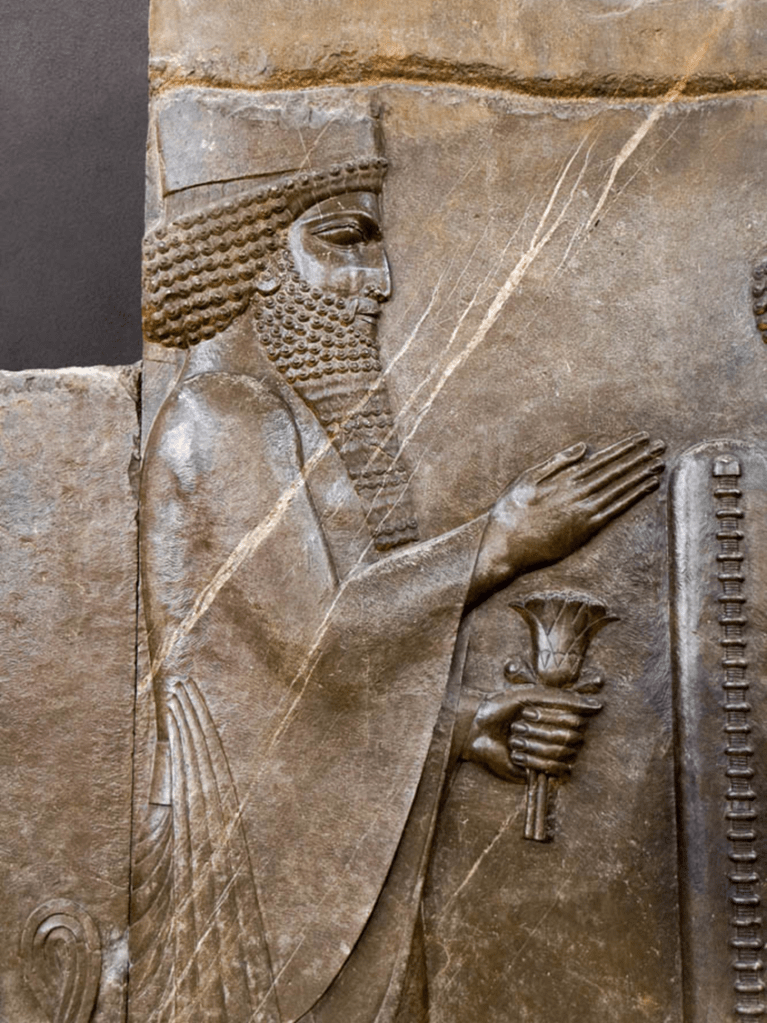
As if that wasn’t dramatic enough, the King’s “Number 2,” Haman the Aggagite loathed his colleague, Esther’s Uncle Mordecai. Like some many before and after him, Haman hated the Jews. Haman’s plot to kill the Jews in the entire kingdom was thwarted when Esther revealed her identity and appealed to the King for the salvation of her people. While Haman was hanged on the gallows he had prepared for Mordecai, Mordecai was elevated as trusted advisor to the King, and the Jewish people were saved once again.
So the Jews celebrate to remember. Esther 9:20-22 reads:
And Mordecai recorded these things and sent letters to all the Jews who were in all the provinces of King Ahasuerus, both near and far, obliging them to keep the fourteenth day of the month Adar and also the fifteenth day of the same, year by year, as the days on which the Jews got relief from their enemies, and as the month that had been turned for them from sorrow into gladness and from mourning into a holiday; that they should make them days of feasting and gladness, days for sending gifts of food to one another and gifts to the poor.
“But where are the “lots,” the purim from which this feast is named?” you ask. The book of Esther tells us that after he set his heart to destroy the Jews, Haman cast lots every day for almost a year, trying to determine when the best time would be to carry out his nefarious plans. Those lots were an ineffective as Haman’s finely cultivated bitterness.
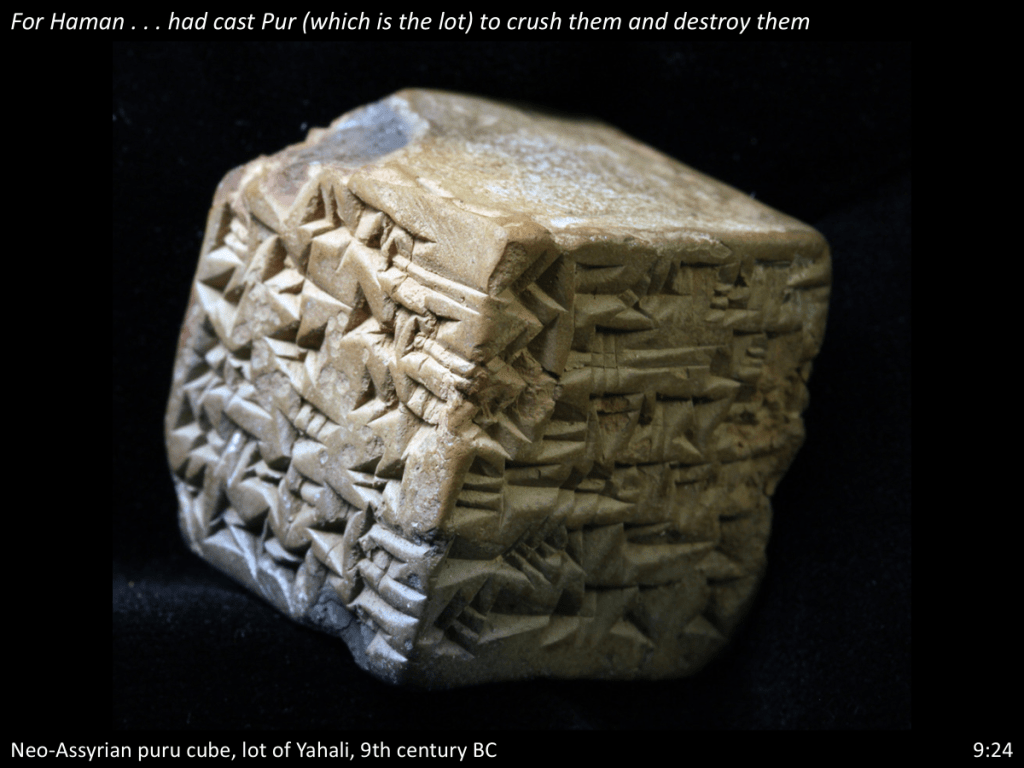
Over the last 2500 years, this feast has accumulated additional practices around it. Special gatherings, foods, and even costumes all appear as a means to help people remember to remember and to teach their children about Purim. Following here are a few of these practices.
The day before the Feast of Purim is the Fast of Esther, reminding the people that Queen Esther asked the Jews around her to fast before she approached her husband. Here we see the shadow of the Almighty as His people cry out to Him for deliverance.
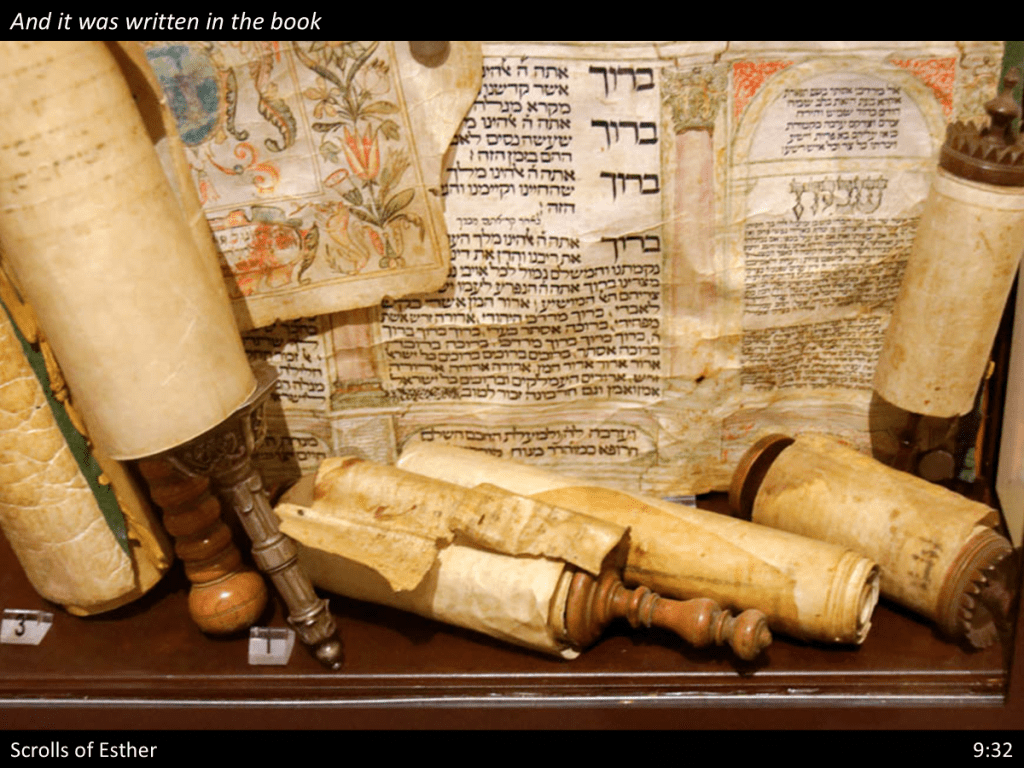
The scroll of Esther (megillah) is read aloud in its entirety in public places, homes, offices, and at the synagogue. In the reading, each time the name “Haman” is mentioned, the listeners boo, use noise makers, and stomp their feet to blot out his name. In some traditions, cheering accompanies the names of Queen Esther and Uncle Mordecai. I will never forget a Purim reading I participated in a cave on the edge of the Maktesh Ramon. As we booed and cheered our way through the ironies and courage and sovereignty of the scroll of Esther, our voices echoed across the wilderness crater even as the impact of story settled in our hearts.
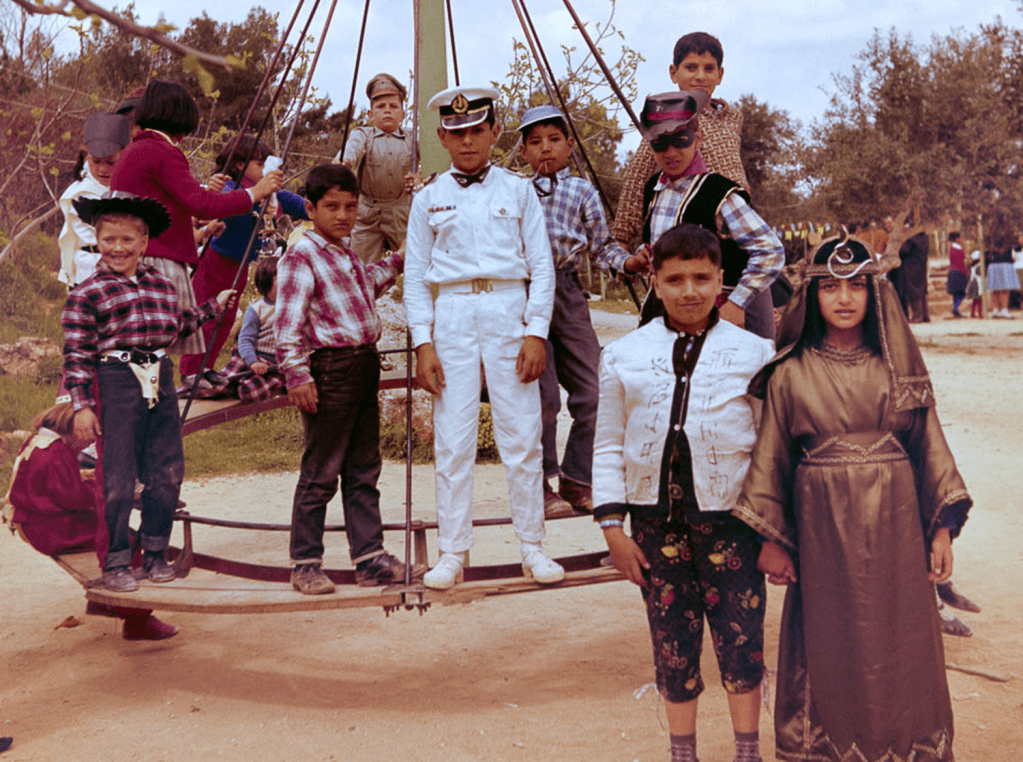
One of the favorite traditions of Purim is dressing up in costumes. Children will often dress up at Esther and Mordechai, but more recent costumes also include super-heroes like Batman and Spiderman. One explanation for the development of costumes is that the masquerade is a reminder of the supposed hidden nature of God in the book of Esther. Indeed, nowhere in the book is the Lord’s name mentioned, but the threads of His providence are everywhere! The continuance of His people would not be thwarted by even the most clever of evil people.
The Synagogue Torah readings for the week include Exodus 17:8-16. These verses, along with 1 Samuel 15 and Deuteronomy 25:17 would serve to remind the Jewish people that Haman the Aggagite (Amalekite) and anti-Semites like him were no match for the covenant-keeping God who would not allow His people to be eradicated.
Remember what Amalek did to you on the way as you came out of Egypt, how he attacked you on the way when you were faint and weary, and cut off your tail, those who were lagging behind you, and he did not fear God. Therefore when the Lord your God has given you rest from all your enemies around you, in the land that the Lord your God is giving you for an inheritance to possess, you shall blot out the memory of Amalek from under heaven; you shall not forget.
As Esther 9 mentioned, the Jewish people celebrated by giving each other gifts of foods. Offerings for the poor are collected by synagogues. And the people feast! Celebrations at home include dishes of chickpeas to “remember” how Queen Esther might have kept kosher in the palace. The most famous of Purim foods is called “Hamantaschen,” or “Haman’s ears,” a three-cornered pastry filled with poppy seeds, chocolate, or jam. Other regions introduce similarly named dishes, such as Moroccan pastry “Haman’s fingers,” or the Bulgarian spaghetti dish called “Haman’s hair.”
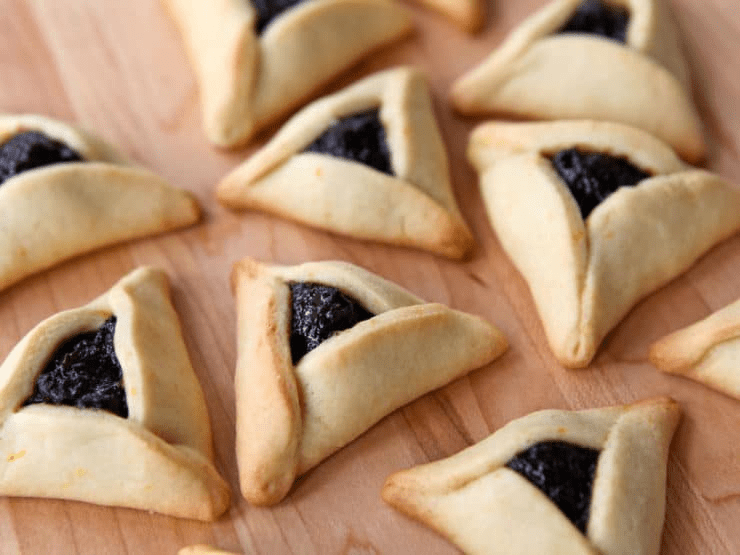
Another interesting feature of Purim is that the rabbi’s recommended that this holiday be celebrated with great joy aided by alcohol. The great Rambam, Moses ben Maimon wrote:
What are a person’s obligations at this feast? One must eat meat and prepare a fine meal according to what one can afford. One should drink wine until he is drunk and fall asleep in his stupor.”(Mishneh Torah, Hil. Megillah ve-Chanukah 2:15)
Others have suggested that one should drink until they were no longer able to distinguish between the names Haman and Mordechai. Such action is, of course, not to be recommended.
For those who read the New Testament, you may be wondering, did Jesus celebrate Purim? Although we don’t know much about the practices of his day, Purim was a celebrated during Jesus time, so my answer would be, yes, probably. Some, like my late friend Gordan Franz, have suggested that the unnamed Feast of John 5 is Purim, but, as I have written before, I believe Rosh Hashanah is a better option than Purim.
As Purim begins this year, the Jewish people all over the world and in Israel are facing similar trials at the hands of modern day Haman types. Iran, the heart of the old Persian empire has been sending rockets into Israel for years now. But for more than 2500 years, Purim has served as a reminder of God’s preservation. Whether it is Bondi Beach or Crown Heights, London, or the Gaza Strip, God cares for his people, and He is calling for them to find their peace in Him, in the Anointed Son. And as for the Hamans of this world, their doom is sure:
Why do the nations rage[a]
and the peoples plot in vain?
2 The kings of the earth set themselves,
and the rulers take counsel together,
against the Lord and against his Anointed, saying,
3 “Let us burst their bonds apart
and cast away their cords from us.”4 He who sits in the heavens laughs;
the Lord holds them in derision.
5 Then he will speak to them in his wrath,
and terrify them in his fury, saying,
6 “As for me, I have set my King
on Zion, my holy hill.”7 I will tell of the decree:
The Lord said to me, “You are my Son;
today I have begotten you.
8 Ask of me, and I will make the nations your heritage,
and the ends of the earth your possession.
9 You shall break[b] them with a rod of iron
and dash them in pieces like a potter’s vessel.”10 Now therefore, O kings, be wise;
be warned, O rulers of the earth.
11 Serve the Lord with fear,
and rejoice with trembling.
12 Kiss the Son,
lest he be angry, and you perish in the way,
for his wrath is quickly kindled.
Blessed are all who take refuge in him.
Thanks to BiblePlaces.com for all of the photos in this post.
 Lisa LaGeorge