As we continue to consider the holy days of observed by the Jewish people, the next to be celebrated is Yom Kippur, the Day of Atonement. It concludes the 10 Days of Awe begun on Rosh Hashanah and is considered to be the holiest day in the Jewish calendar. Yom Kippur is distinguished as the only biblical holy day which practices a fast. In 2025, Yom Kippur will begin at sunset on October 1 and continues through sunset on October 2.

What does the word “atonement” mean? “Atone” is a word which sounds rather old-fashioned to the modern ear. The Hebrew word literally means “covering,” like the covering of the wings over the Ark of the Covenant or the covering the head with a kippah. What was to be covered? The sin of the people. God gave His Law to the people, but they were not, are not able to keep it. God provided a way for the people of Israel to be restored to a right relationship with Him by the covering of sin.
What is the origin of Yom Kippur? Yom Kippur is first described in Leviticus, and the summary in Leviticus 23:26-28 says this:
Now on the tenth day of this seventh month is the Day of Atonement. It shall be for you a time of holy convocation, and you shall afflict yourselves and present a food offering to the Lord. And you shall not do any work on that very day, for it is a Day of Atonement, to make atonement for you before the Lord your God…
In Leviticus 16, Yom Kippur was first celebrated at God’s command during the wilderness wanderings. Moses’s brother Aaron was the High Priest of Israel, and he was commanded to cleanse himself, put on white linen garments, and make two sacrifices before the Lord to atone for sin: a bull for his own sin, a goat for the sin of the people. When the sacrifices were accomplished, the High Priest was to enter the Holy of Holies to sprinkle the blood on the Mercy Seat of the Ark of the Covenant. He took a second goat, laid his hands on the head of the goat and confessed all the sins of the people. This “scapegoat” was taken away into the wilderness and set free, representing the removal of sin from the people.
Yom Kippur was intended to be a type of Sabbath day for the people. Leviticus says three times that they were to do no work. They were to cleanse themselves, “afflict” themselves, and wait. According to Leviticus, the people’s part was to wait for the High Priest to do the work.
What happens in Yom Kippur now that there is no High Priest or temple? Without the temple to maintain the sacrificial system, religious Jews have developed other ways of observing Yom Kippur. Rabbinical writings have led to three main activities which substitute for the sacrifices: prayer (tefillah), repentance (Teshuvah), and good works (tzedakah). Additionally, the rabbis admonish the people to abstain from pleasurable activities. The Mishnah (rabbinic commentaries on the Scriptures) in Yoma 8:1 outlines five “afflictions” of Yom Kippur: no eating, drinking, bathing, anointing, wearing leather shoes, or sexual relations.
In a few Jewish communities a form of blood sacrifice is still offered. A chicken, the kapparot, stands in for the goat, and the father will gather his family, hold the chicken over their heads, and recite prayers of repentance. The chicken is then killed and given to the poor. Increasingly, money is now the substitute for the substitute chicken.

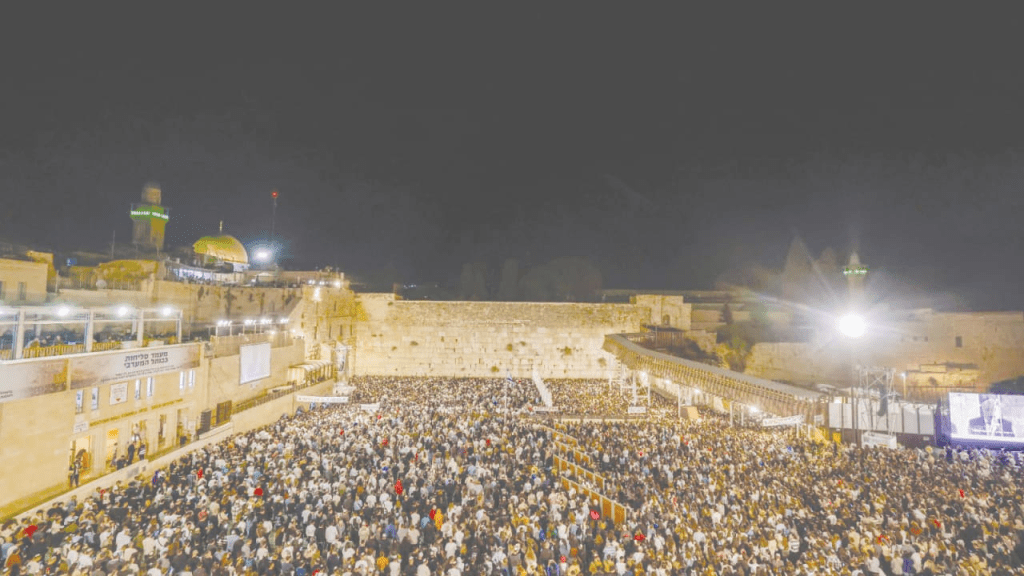
The streets in Israel are empty of cars, and the land is uncharacteristically quiet. Almost everyone attends synagogue services, even if they never attend at any other time of the year.
What is included in services during Yom Kippur? As night falls, opening Yom Kippur, the people gather, raise the Torah scrolls and the Kol Nidre prayer is offered. Jonathan Lieberman muses about Kol Nidre in The Jerusalem Post:
Kol Nidre is not a performance. It is a confession of weakness, wrapped in communal strength. When the congregation sings together, the individual no longer feels alone in failure. We stand as one body, admitting our fragility, forgiving each other, daring to hope that God will forgive us too.

As the fast continues the entire next day, communal confessions are recited aloud together. Scripture readings for the day often include the following:
- Isaiah 57:14-58:14 Isaiah rebukes of the people’s empty rituals and calls for their repentance.
- Jonah: In spite of Jonah’s reluctance, God grants mercy to penitent Nineveh.
- Psalms 27, 51, and 130: “Create in me a clean heart of God.”
A final service, neilah, includes prayers offered with increasing urgency as the day draws to a close. A long blast of the shofar marks the end of this season of repentance.
How do Christians understand Yom Kippur, the Day of Atonement? Those who follow Jesus as the Messiah see Yom Kippur as a holiday which looks backward. Yes, we are sinful, we too have sinned against each other and against God. We, however, believe that Jesus is both our High Priest and the sacrifice for our sins. He is our covering, our atonement–once and forever.
In the Gospel of Matthew (one of the four books of the New Testament which tells of the birth, life, crucifixion, and resurrection of Jesus) Matthew writes that Jesus was so named because, “He shall save His people from their sin.” Matthew intended for his Jewish readers to hear the echo of the prophet Isaiah:
Surely he has borne our griefs
and carried our sorrows;
yet we esteemed him stricken,
smitten by God, and afflicted.
But he was pierced for our transgressions;
he was crushed for our iniquities;
upon him was the chastisement that brought us peace,
and with his wounds we are healed.
All we like sheep have gone astray;
we have turned—every one—to his own way;
and the Lord has laid on him
the iniquity of us all. (Is 53:4-6)
Our sin, the sin of the people, was laid on Jesus, and He became the substitutionary atonement for all who find refuge in His work. He takes on Himself our sin.
The New Testament letter to the Hebrews was written to Jewish followers of Jesus in the first Century BCE who were struggling to believe in Him in the face of persecution from every side. “Don’t turn back,” the writer told these Hebrews. “Jesus is the sympathetic great High Priest who was better than Moses and better than the High Priests who have come before Him.”
For it was indeed fitting that we should have such a high priest, holy, innocent, unstained, separated from sinners, and exalted above the heavens. He has no need, like those high priests, to offer sacrifices daily, first for his own sins and then for those of the people, since he did this once for all when he offered up himself. For the law appoints men in their weakness as high priests, but the word of the oath, which came later than the law, appoints a Son who has been made perfect forever. (Hebrew 7:26-28)
Jesus didn’t need a bull to sacrifice for His own sins. Instead, he offered up Himself to provide salvation for all who would look to Him.
Christians look at Yom Kippur differently than do our Jewish friends. We have no need to fast, to pay alms, or to do good works (although none of those things are evil). Instead, we wait for Jesus as the High Priest who has finished the all the work. For Christians, Yom Kippur is a day of rejoicing. We believe the scriptures tell us that we were once alienated from God by our sin, but Jesus has brought us near. We can, “with confidence, draw near to the throne of grace, that we may receive mercy and find grace to help in time of need.”

Christians also believe that Jesus extends an invitation to all who are trying to scramble toward God on their own. Listen to these kinds words that He offers:
Come to me, all who labor and are heavy laden, and I will give you rest. Take my yoke upon you, and learn from me, for I am gentle and lowly in heart, and you will find rest for your souls. For my yoke is easy, and my burden is light.” (Matthew 11:28-30)
In this weary world, all who come to Him can find rest in Jesus.
You can find more on Jewish holidays here and Rosh Hashanah here. Next up: Sukkot!
Again, thanks to www.BiblePlaces.com for the fabulous photos!
Some Jewish Christians point out that the Talmud weighs in on a major event that changed Yom Kippur in the first Century. Check it out!
 Lisa LaGeorge
[…] to remember. This is God’s instruction to His people. Whether Yom Kippur or Rosh Hashanah or even Hanukkah, each of these holidays reminds the people what He has done. […]
LikeLike